Jan 13, 2011

"Tiger-Mask" movement

Recently, there have been heartwarming news in Japan that is called "Tiger Mask" movement.(タイガーマスク運動) In the end of December of last year, a man who called himself "Date Naoto"(伊達直人) gave "randoseru"(ランドセル), small school backpacks to children living in orphanage. Several days later, another "Date Naoto" appeared in another place and left several gifts to an orphanage. And also third "Date Naoto" appeared in a different place. Finally, these kind of donations have been over one thousand.

"Date Naoto" is a main character of an animation movie named "Tiger Mask" in the 1970's.(Its original is a comic.) In the story, "Tiger-Mask" is a masked professional wrestler and no one knows that he is "Date Naoto". "Date Naoto" donates several gifts using the name of "Tiger-Mask" to an orphanage where he grew up.

When I was considering this movement, a spiteful idea appeared in my mind. If the first donor used the name "Kan Naoto"(菅直人), the Japanese prime minister, how much the movement might have spread?

Many people say that the animation's ending song is one of the saddest songs in Japanese animation movies.

Jan 8, 2011

"Chi-Deji-ka"


On January 3 of this year, my family bought a TV set that can receive "digital terrestrial broadcasting" because "analogue terrestrial broadcasting service" in Japan will end July of 2011.

"Chi-Deji-ka"(地デジ化) is an abbreviated form of "Chijyou-Digital-Housou-ka"(地上デジタル放送化) that means "analogue broadcast will fully switch over to digital broadcast by July 2011. But, for most people including me, it means that people in Japan buy the latest TV set that receives "digital broadcasting".

The 37" TV set is a product of Toshiba and its price was 128,000 yen. I felt that it is a little bit expensive but I have been satisfied with its beautiful picture and its monitor size.

Jan 3, 2011

"Nenga-jyou"


In Japanese custom, people exchange new year message card called "Nenga-jyou" (年賀状) between close members on January 1st. But, people who lost their close family member do not send "Nenga-jyou", instead, they send "Mochu-hagaki" (喪中はがき) in the first of December.

But, I did not follow this custom because it passed about one year from my father's death and I won't let my friends to know my father's death in this kind of style. So, this year, I decided to send a simple "Nenga-jyo" to friend who sent it to me on January 1st.

Dec 30, 2010

"Fugu(Fuku)"


In a recent few years, our family had spent one-night at "onsen" in Kyushu in the end of December.But, this year, we gave it up from several reasons. Instead, we decided to have a luxurious dinner in Kokura.

Yesterday's our dinner was "Fugu(Fuku) no full-cource"(ふぐのフルコース) that included "Fugu-sashi"(ふぐ刺し), "Shirako-iri Chawan-mushi"(白子入り茶碗蒸し),"Kara-age"(唐揚げ), "Fugu-nabe"(ふぐ鍋). I and my wife drunk "(Fugu) Hire-zake"(ひれ酒) that is Sake with baked "Fugu"'s fins.

Our table was in a separated room, so we spent a very relaxed relaxing time.

Dec 23, 2010

Candle lights event


Last Saturday, an event called "Orio-Haku Toumyou de X'mas"(おリオ博 灯明 de X'mas) was held near JR Orio station(JR折尾駅). In this event, people placed a lot of candles covered by paper backs on the ground to create fantastic atmosphere.

In its opening event, my son's wind orchestra band performed two songs, "Winter Wonderland" and "Rudolph the Red-Nosed Reindeer"(赤鼻のトナカイ).

It was a little bit cold, but their performance gave audiences hot,peaceful feelings.

Dec 21, 2010

Christmas lights in Kokura


IMG_0786.JPG, originally uploaded by bikenglish.

In this season, we often see beautiful lights here and there. This time, I took several photos of Christmas lights nearby my work office.

Dec 13, 2010

Unemployed Man


I have learned "Unemployed Man" thorough VOA Special English program. I like this kind of naming to the characters in comics. It reminds me of "Kobayashi Yoshinori"(小林よしのり)'s comics. For example, in his well-known work named "Toudai Ittyoku-sen" (東大一直線), the main character's name is "Toudai Touru"(東大通).


Dec 6, 2010

"Motsu-nabe"

"Motsu-nabe"(もつ鍋) has become a popular food for ordinary people in Japan. Generally, "motsu" means animal's internal organ, but in this case, it means bovine's intestine.

Last Saturday, I took part in a party of parent's group of my son's high school wind orchestra club. There, I ate "motsu-nabe" drinking beer.

People in Japan can get "Motsu" in low price because it used to be thrown away in the past. So, "motsu-nabe" is a less expensive food.

Nov 21, 2010

Autumn leaves in Fukuchiyama


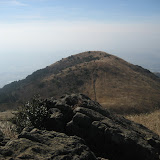
The Fukuchi-yama(福智山) is the highest mountain in my area. It is about 900 meters high. The top of the mountain has no obstruction for viewers, so people can enjoy panorama there. It is one of my favorite mountains.

Last Sunday, I climbed it with my several old friends. I have ever climbed the mountain several times in the past, however it was the first time for me in five years.

It was very fine and the autumn leaves looked very beautiful. We enjoyed a good day in autumn.

Nov 14, 2010

AERA's short message


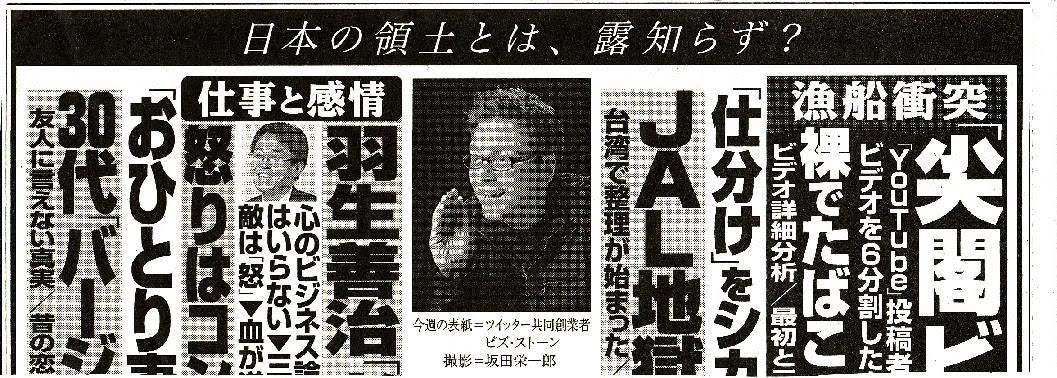
"AERA"(アエラ) is a weekly magazine released by Asahi Shimbun(朝日新聞). I am looking forward to seeing a short message in its advertisement on a newspaper each week because it let me chuckle every time. It contains a kind of "word play".

This time, I try to explain it. We often use only one Kanji character to express a country's name or itself. For example, "米(べい)" means the United States of America. "仏(ふつ)" means France. "露(ろ)" means Russia and it also can be pronounced "つゆ". And "つゆ知らず in Japanese means that (a person has) "unconsciously" (done wrong or done something that he does not plan to do at first).

So, "日本の領土とは、露知らず?" has two means. The first is "it(or he) did something but it has been unconscious that it is Japanese territory". Another mean is "Russia has not known (or learned) that it is Japanese territory".

There has been a dispute on small islands near Hokkaido(北海道) between Japan and Russia. It is one of on-going issues that Japan has faced now. You can learn more about this problem here.